
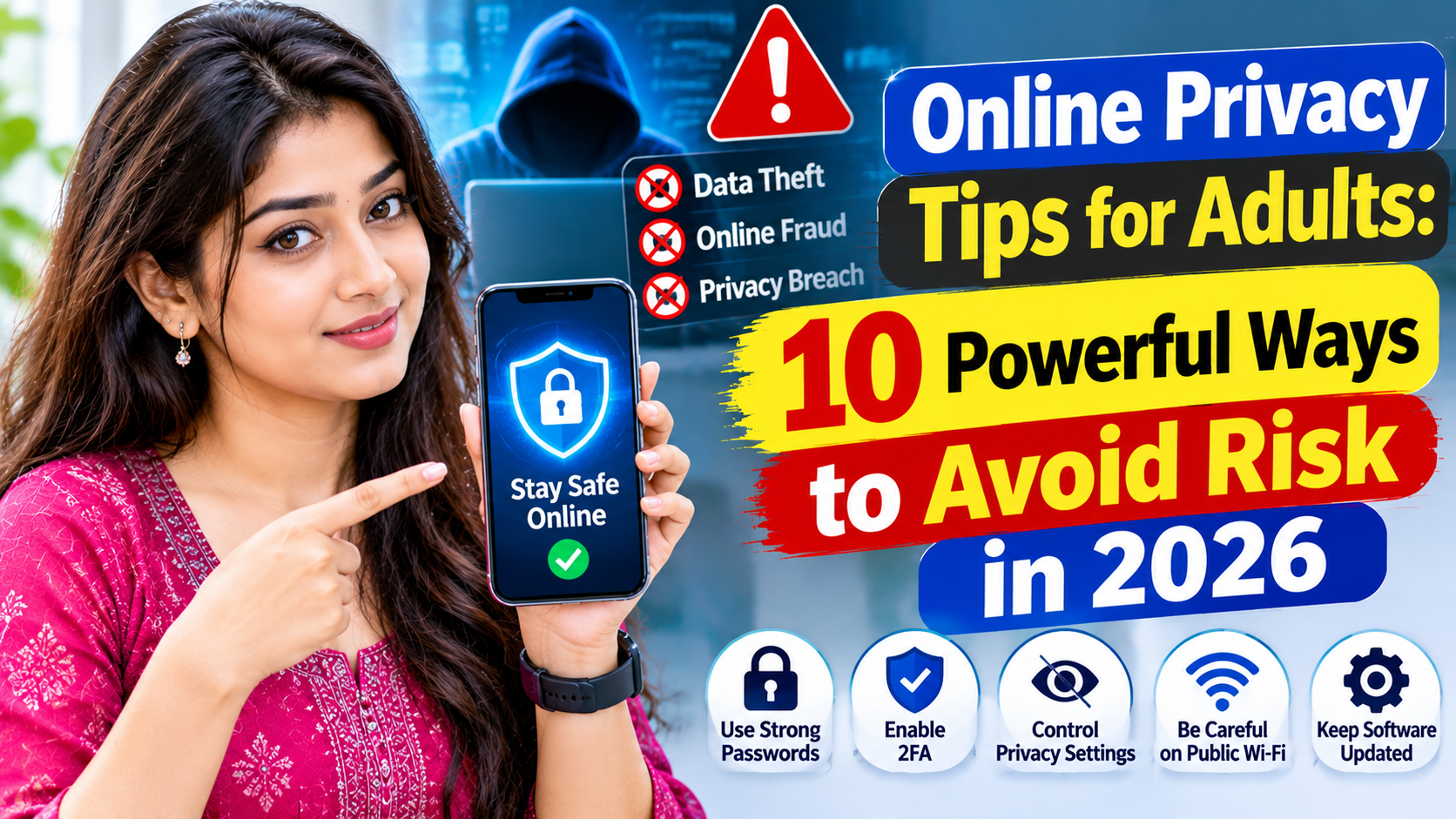
Online Privacy Tips for Adults: 10 Powerful Ways to Avoid Risk in 2026
information, secure digital accounts and recognize common online
risks. This practical guide explains privacy settings, password
safety, identity protection, responsible communication and scam
awareness for adults using websites, social media and messaging
applications.
Introduction to Online Privacy Tips for Adults
Online Privacy Tips for Adults are important
because everyday internet activities can expose personal
information in unexpected ways. Browsing websites, using social
media, sending messages, shopping online and accessing financial
applications may involve sharing data.
Some information is shared intentionally, while other details
may be collected through cookies, application permissions,
account settings or online tracking technologies. If personal
information reaches an untrusted person or platform, it may
create risks such as identity misuse, unwanted contact,
impersonation or financial fraud.
Adults can reduce these risks by understanding how information
is shared and taking practical steps to protect their digital
identity. This guide covers ten useful privacy habits that
can be applied to everyday internet use.
secure accounts and responsible online habits.
1. Understand Why Online Privacy Matters
Online privacy means having appropriate control over how
personal information is collected, used, stored and shared.
It includes information such as your name, email address,
phone number, photographs, location history and account details.
Not every website or application handles information in the
same way. Some services collect information to provide their
features, while others may use data for analytics,
personalization or advertising.
Before creating an account, review the website’s privacy policy.
Look for information about data collection, storage, sharing,
retention and available privacy controls.
Important Privacy Reminder
A privacy policy explains a website’s stated data practices.
It should not automatically be treated as proof that the
website is trustworthy or completely secure.
2. Create Strong and Unique Passwords
Passwords protect access to email accounts, social media,
financial services and other online platforms. Reusing
the same password across multiple websites can increase
the consequences of a data breach.
How to Improve Password Security
- Use a different password for every important account.
- Choose long passwords that are difficult to guess.
- Avoid names, birthdays and predictable number combinations.
- Consider using a reputable password manager.
- Change passwords if you suspect an account has been compromised.
- Never share passwords through messages or email.
A password manager can help generate and store unique passwords.
Protect the manager itself with a strong master password and
additional authentication where available.
3. Enable Two-Factor Authentication
Two-factor authentication adds another verification step
when someone attempts to access an account. Depending on
the service, this may involve an authentication application,
security key or another supported verification method.
Even if someone discovers your password, an additional
authentication requirement can make unauthorized access
more difficult.
Accounts That Deserve Extra Protection
- Primary email accounts.
- Banking and financial service accounts.
- Social media profiles.
- Cloud storage accounts.
- Business and website administration accounts.
Security Warning
Never share one-time passwords, authentication codes
or account recovery codes with unknown people.
Legitimate support representatives should not ask
you to disclose your login verification codes.
5. Limit How Much Personal Data You Share Online
One of the most effective Online Privacy Tips for Adults
is to share only the information necessary for a particular
purpose. Not every website needs access to your full name,
address, contact list or identification documents.
Before submitting a form, consider why the information is
being requested and whether it is genuinely necessary.
Avoid uploading sensitive documents to unknown websites.
Information to Handle Carefully
- Home address and personal phone number.
- Government identification documents.
- Banking details and financial account information.
- Private photographs and personal videos.
- Workplace and daily travel information.
- Account recovery details and security answers.
Remember that information shared privately may still be
copied, forwarded or stored elsewhere. Consider the
consequences before sending sensitive material.
6. Recognize Phishing Messages and Online Scams
Phishing is a technique used to trick people into revealing
sensitive information or opening harmful links. A message
may pretend to come from a bank, delivery company, social
media platform or another familiar organization.
Common Phishing Warning Signs
- Unexpected messages asking you to verify account details.
- Links containing misspelled or unfamiliar domain names.
- Urgent warnings about account closure or security problems.
- Attachments you were not expecting.
- Requests for passwords, PINs or verification codes.
- Offers that appear unusually attractive or unrealistic.
Avoid clicking suspicious links. Instead, open the official
website or application directly and check your account
notifications there.
For further guidance, visit
CISA Secure Our World
and
FTC Consumer Advice
.
7. Protect Your Smartphone, Computer and Applications
Your phone and computer may contain private messages,
saved passwords, photographs, financial applications
and location information. A poorly secured device can
expose several accounts at once.
Practical Device Protection Habits
- Install operating system and application updates.
- Use a secure screen lock.
- Download applications from trusted sources.
- Review camera, microphone and location permissions.
- Remove applications that you no longer use.
- Back up important files securely.
- Avoid opening unexpected attachments.
Be careful when giving applications access to contacts,
photographs, microphones or location services.
Grant permissions only when they are needed for
a feature you actually use.
8. Use Public Wi-Fi and Shared Devices Carefully
Public Wi-Fi in cafes, hotels, airports and other shared
spaces can be convenient. However, users should be careful
when connecting to unfamiliar networks.
A network name alone does not prove that a connection
is genuine. Avoid accessing sensitive accounts through
suspicious networks and never ignore browser security
warnings.
Safer Public Internet Habits
- Confirm the correct network name with the venue.
- Avoid entering financial information on unfamiliar networks.
- Keep device sharing features disabled when unnecessary.
- Do not save passwords on shared computers.
- Sign out of accounts after use.
- Use your mobile data connection for sensitive activities when appropriate.
9. Respect Digital Consent and Personal Boundaries
Privacy also applies to other people. Sharing someone’s
photographs, private messages, personal details or recordings
without permission can cause serious harm.
Digital consent means respecting another person’s decision
about how their personal information and content may be used.
Permission to receive a message or photograph does not
automatically mean permission to publish or forward it.
Responsible Online Communication
- Ask permission before sharing another person’s private content.
- Respect requests to stop unwanted communication.
- Never use private information for threats or blackmail.
- Do not create fake accounts using someone else’s identity.
- Avoid publishing private conversations without permission.
Respectful communication and clear personal boundaries
are essential parts of a safer online environment.
10. Online Privacy Tips for Adults: Daily Safety Checklist
Building good privacy habits does not require complicated
technology. Small actions performed consistently can
improve the protection of personal information.
10 Essential Privacy Checks
- Do I use unique passwords for important accounts?
- Is two-factor authentication enabled where available?
- Have I reviewed my social media privacy settings?
- Am I sharing only necessary personal information?
- Do I check links before opening them?
- Are my phone and computer software up to date?
- Have I reviewed application permissions?
- Do I avoid sharing verification codes?
- Am I respecting other people’s digital privacy?
- Do I know how to report suspicious online activity?
Reliable Resources for Online Privacy and Security
Official cybersecurity organizations and consumer-protection
resources provide useful information about digital safety.
Use recognized sources when learning about privacy,
account security and online fraud prevention.
Recommended External Resources
Bangladesh e-GOV CIRT
for cybersecurity awareness in Bangladesh.
Bangladesh Police
for official police information.
CISA Secure Our World
for practical online security guidance.
FTC Consumer Advice
for consumer protection and scam awareness.
National Cybersecurity Alliance
for digital safety education.
Frequently Asked Questions About Online Privacy Tips for Adults
Why are Online Privacy Tips for Adults important?
They help adults understand how personal information
can be exposed, recognize digital risks and develop
safer habits when using websites, applications
and social media.
What personal information should I avoid sharing publicly?
Avoid publicly sharing sensitive details such as home
addresses, identification documents, financial information,
account recovery details and private photographs.
How often should I review privacy settings?
Review privacy settings regularly, especially after
application updates, changes to account features
or the addition of new connected applications.
Is a strong password enough to protect an account?
A strong, unique password is important, but it should
be combined with additional protections such as
two-factor authentication and account recovery security.
How can I recognize a phishing message?
Look for unexpected requests, suspicious links,
urgent threats, unusual attachments and requests
for passwords or verification codes.
What should I do if my personal information is exposed?
Secure affected accounts, change compromised passwords,
enable additional authentication and preserve relevant
evidence. Contact the relevant service provider or
appropriate authorities when necessary.
Where can I read a website’s privacy policy?
Look for a Privacy Policy link in the website’s footer
or navigation menu. Read how the website describes
collection, storage and sharing of personal information.
Does this guide guarantee complete online privacy?
No. No single guide or security measure can guarantee
complete privacy. These recommendations can help
reduce common risks, but users should continue
reviewing their security practices.
Conclusion: Build Better Online Privacy Habits
These Online Privacy Tips for Adults explain
practical ways to protect personal data, secure digital
accounts and recognize common online threats. Strong
passwords, two-factor authentication, careful information
sharing and responsible communication can all contribute
to better digital privacy.
Online safety is an ongoing responsibility. Review privacy
settings regularly, keep devices updated and use reliable
sources when you need security guidance. Most importantly,
protect your own information and respect the privacy
and boundaries of others.
Educational content only. This article provides general
digital privacy information and does not replace
professional cybersecurity or legal advice.
4. Review Social Media Privacy Settings
Social media platforms can reveal personal details through
photographs, posts, comments, location tags and public
profile information. Even small details may become useful
to someone attempting to impersonate or target an account.
Social Media Privacy Practices
Privacy settings may change when platforms update their
applications. Review them regularly rather than assuming
that your previous choices remain unchanged.