
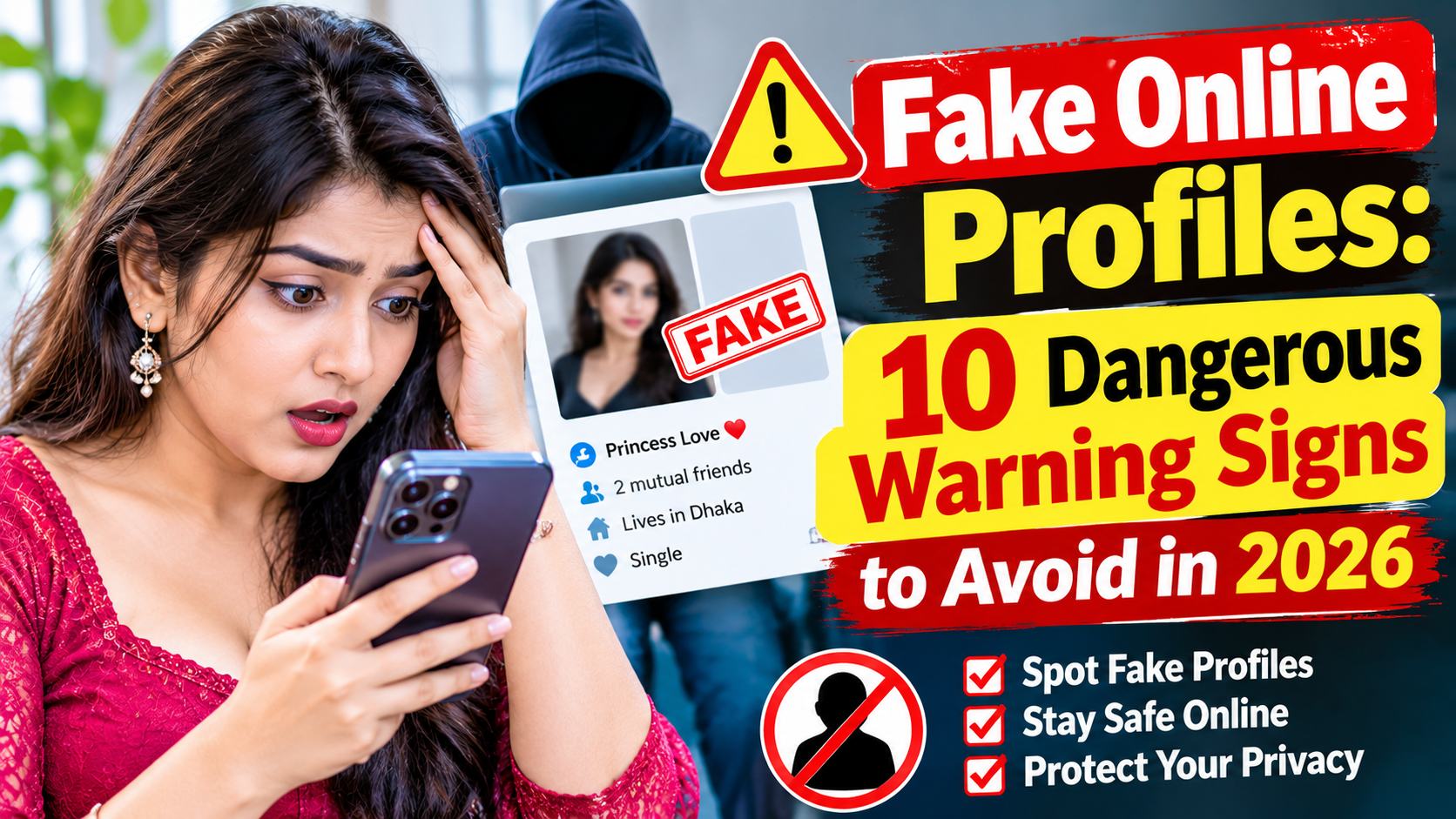
Fake Online Profiles: 10 Dangerous Warning Signs to Avoid in 2026
impersonation, privacy violations and financial scams. Learn how
to recognize suspicious accounts, identify copied photographs,
protect personal information and respond responsibly when an
online profile appears misleading or fraudulent.
Introduction to Fake Online Profiles
Fake Online Profiles are accounts that use false,
misleading or unauthorized information to represent a person,
organization or identity. They may appear on social media,
messaging platforms, websites, online communities and other
digital services.
Some suspicious accounts use stolen photographs, invented names,
copied biographies or misleading personal details. Others may
imitate genuine individuals or organizations to gain trust,
collect information or encourage users to take risky actions.
Not every incomplete or anonymous profile is fraudulent.
However, inconsistent details, suspicious requests and
attempts to obtain sensitive information deserve careful
attention.
Understanding how Fake Online Profiles operate can help adults
make better decisions, protect their digital identities and
avoid common online risks.
Spa with Sex: Facts, Myths and What Customers Should KnowHigh Class Escort Secrets: 4 Ways to Elevate Your Intimate Life
personal information from impersonation and misuse.
1. What Are Fake Online Profiles?
Fake Online Profiles are digital accounts that misrepresent
identity, ownership, background or other important information.
They may be created using fabricated details or information
copied from genuine people without permission.
These accounts can appear convincing because they may contain
profile photographs, personal descriptions, posts, comments
and lists of connections. However, these elements do not
independently prove that an account belongs to the person
it claims to represent.
Common Types of Fake Profiles
- Impersonation accounts: Accounts pretending to be another person.
- Stolen-photo accounts: Profiles using photographs without permission.
- Fabricated identities: Accounts created with invented personal details.
- Business impersonation: Accounts pretending to represent a genuine organization.
- Scam accounts: Profiles designed to manipulate users or obtain information.
Important Awareness Point
A profile photograph, follower count or professional-looking
biography does not guarantee that an online identity is genuine.
Look for reliable evidence rather than relying on appearance.
2. Fake Online Profiles: 10 Dangerous Warning Signs
Recognizing suspicious patterns can help you avoid misleading
accounts. One warning sign alone may not prove fraud, but several
inconsistencies together deserve additional attention.
Warning Sign 1: Inconsistent Personal Information
A profile may display different names, locations, occupations
or background details across different platforms. Significant
inconsistencies should encourage you to verify information
before trusting the account.
Warning Sign 2: Copied or Reused Photographs
Some fake accounts use photographs taken from public websites
or other social media profiles. If an image appears under
different names or unrelated accounts, it may indicate
unauthorized reuse.
Warning Sign 3: Very Limited Account History
A recently created account with little activity may deserve
closer attention, especially when it immediately makes
unusual requests. However, new accounts are not automatically
fraudulent.
Warning Sign 4: Unusual Requests for Personal Information
Be cautious when an unfamiliar account asks for identification
documents, private photographs, passwords, financial details
or account verification codes without a legitimate reason.
Warning Sign 5: Pressure and Urgency
Suspicious accounts may create urgency by claiming that an
opportunity will disappear or that an account will be closed.
Pressure can discourage people from checking information
carefully.
Warning Sign 6: Suspicious External Links
Unexpected links may lead to imitation websites, phishing
pages or harmful downloads. Avoid opening unfamiliar links
simply because they come from an attractive or convincing
profile.
Warning Sign 7: Requests for Verification Codes
Never disclose one-time passwords, authentication codes
or account recovery information to unknown contacts.
These details may allow someone to access your accounts.
Warning Sign 8: Unusual Financial Requests
Unexpected money requests, advance-payment demands and
suspicious financial instructions can indicate attempted
fraud. Verify any financial claim independently.
Warning Sign 9: Avoiding Reasonable Verification
An account may repeatedly avoid basic questions or provide
contradictory explanations. This does not prove wrongdoing,
but it is a reason to avoid sharing sensitive information.
Warning Sign 10: Threats or Emotional Manipulation
Threatening messages, blackmail, intimidation and attempts
to create emotional pressure are serious warning signs.
Preserve relevant evidence and use appropriate reporting
channels.
3. How Copied Photos Can Make Fake Online Profiles Look Real
Photographs can create a strong impression of authenticity.
Unfortunately, an image can be copied from a public website
or social media account and reused without the owner’s
permission.
This can make a fabricated profile appear more believable.
Users should remember that a photograph does not independently
establish someone’s identity, location or background.
Practical Image Awareness Checks
- Look for inconsistencies between photographs and profile details.
- Check whether the same image appears in unrelated contexts.
- Use reputable reverse-image search tools when appropriate.
- Avoid making public accusations based only on image similarities.
- Respect the privacy and rights of the person shown in a photograph.
Image search results can provide useful clues, but they cannot
always confirm who owns a photograph or whether an account
is fraudulent.
4. Identity Theft and Online Impersonation Risks
Identity theft happens when someone uses another person’s
identifying information without permission, often for
deceptive or harmful purposes. Online impersonation may
involve copying a person’s name, photograph, biography
or other identifying details.
The consequences can include damaged reputation, unwanted
communication, financial loss, privacy violations and
difficulties recovering control over an online identity.
How to Reduce Identity Misuse Risks
- Limit the personal information visible on public profiles.
- Use unique passwords for important accounts.
- Enable two-factor authentication.
- Review account login activity and connected devices.
- Secure your primary email account.
- Avoid sharing identification documents with unknown contacts.
If someone creates an account using your identity, preserve
screenshots, profile links and relevant messages. Use the
platform’s official impersonation reporting process.
5. How Fake Online Profiles Are Used in Scams
Fake accounts may be used to build trust before attempting
to obtain money, personal information or access to online
accounts. Some scams involve emotional manipulation,
fraudulent investment claims, fake employment offers
or impersonation of familiar organizations.
Common Scam Patterns
- Unexpected requests for money from unfamiliar accounts.
- Messages claiming that urgent financial assistance is needed.
- Fake job offers requesting sensitive information.
- Investment promises that appear unrealistic.
- Links asking users to enter account credentials.
- Threats involving private photographs or personal information.
Scam Prevention Reminder
Never send passwords, PINs or one-time verification codes
to an unknown person. Do not transfer money simply because
a profile claims to represent someone you recognize.
For additional consumer protection guidance, visit
FTC Consumer Advice.
6. Protecting Your Privacy From Fake Online Profiles
Good privacy habits can reduce the amount of information
available to people attempting impersonation or identity misuse.
You do not need to make every account public or share personal
details to participate online.
Essential Privacy Protection Habits
- Review who can view your profile and posts.
- Limit public access to your phone number and email address.
- Avoid posting real-time location details.
- Do not share private photographs with unknown contacts.
- Review account tagging and mention settings.
- Remove unnecessary third-party application permissions.
- Use strong passwords and additional authentication.
Read our related
identity and fake profile awareness guide
for more information about protecting personal identity.
7. How to Check the Credibility of an Online Profile
Before trusting an unfamiliar account, review the available
information carefully. Do not rely on a single photograph,
testimonial, follower count or profile description.
A Practical Profile Review Process
- Check whether the profile information is consistent.
- Review the account’s public history where available.
- Look for signs that photographs may have been copied.
- Check whether external links lead to genuine websites.
- Be cautious about requests for sensitive information.
- Verify organizational claims through official channels.
A profile review cannot guarantee authenticity. Some genuine
users maintain limited public information, while deceptive
accounts may look professional. Treat the process as a way
to identify warning signs, not as a complete identity check.
For general online security advice, consult
CISA Secure Our World.
8. How to Report Fake Online Profiles Responsibly
If you discover an account that appears to impersonate you
or another person, use the platform’s official reporting
tools. Reporting procedures vary between social networks
and digital services.
Steps to Take When Reporting an Account
- Save screenshots of the suspicious profile and relevant messages.
- Record the account’s public profile address.
- Preserve dates and other relevant details.
- Use the platform’s impersonation or fraud reporting option.
- Secure your own accounts if your identity may be affected.
- Avoid confronting or threatening the account owner.
If the situation involves financial fraud, threats or
serious privacy violations, consider contacting the
appropriate authorities or seeking qualified professional
advice.
Useful official resources include
Bangladesh Police
and
Bangladesh e-GOV CIRT.
9. Fake Online Profiles: Personal Safety Checklist
Use this checklist when reviewing an unfamiliar profile
or receiving an unexpected online message.
10 Essential Identity Protection Checks
- Have I checked whether the profile details are consistent?
- Could the photographs have been copied from another source?
- Am I avoiding unnecessary personal information sharing?
- Have I avoided opening suspicious external links?
- Am I protecting my passwords and verification codes?
- Have I enabled additional account security?
- Am I checking financial requests independently?
- Have I saved evidence of suspicious activity?
- Do I know how to report impersonation?
- Am I respecting other people’s privacy and identity?
10. Reliable Resources for Fake Profile and Identity Protection
Official cybersecurity organizations and consumer protection
resources provide useful information about impersonation,
phishing, privacy and digital security. Use recognized
sources rather than relying on anonymous online claims.
Recommended External Resources
Bangladesh e-GOV CIRT
for cybersecurity awareness.
Bangladesh Police
for official police information.
FTC Consumer Advice
for consumer fraud awareness.
CISA Secure Our World
for practical cybersecurity guidance.
National Cybersecurity Alliance
for online safety education.
Google Safe Browsing
for website safety information.
Frequently Asked Questions About Fake Online Profiles
What are Fake Online Profiles?
Fake Online Profiles are accounts that use false,
misleading or unauthorized information to represent
a person, organization or identity.
How can I recognize a fake online profile?
Look for inconsistent personal details, copied photographs,
suspicious links, unusual financial requests and attempts
to obtain sensitive information.
Are all newly created profiles fake?
No. Genuine users may create new accounts for many reasons.
Account age alone cannot establish whether a profile is
authentic or fraudulent.
Can a real photograph be used in a fake profile?
Yes. Someone may copy a genuine person’s photograph
and use it without permission. A photograph alone
does not prove the identity of an account owner.
What should I do if someone impersonates me online?
Preserve screenshots and profile links, secure your accounts
and report the impersonation through the platform’s
official reporting process.
Should I send money to someone I only know online?
Be cautious with unexpected financial requests.
Independently verify the person’s identity and the
reason for the request before taking any financial action.
Can reverse-image search identify a fake profile?
Reverse-image search may help find where a photograph
appears online, but it cannot independently confirm
identity or prove that an account is fraudulent.
Where can I learn more about online privacy?
Consult recognized cybersecurity organizations,
consumer protection resources and relevant website
privacy policies. You can also review our
Privacy Policy resource
and
Frequently Asked Questions.
Does this guide verify whether a specific account is genuine?
No. This article provides general educational guidance.
It does not authenticate individual accounts or replace
official platform investigations.
Conclusion: Stay Alert and Protect Your Digital Identity
Fake Online Profiles can create risks involving
impersonation, privacy violations, financial scams and misuse
of personal information. Learning to recognize suspicious
account behavior is an important step toward safer internet use.
Review profile information carefully, avoid sharing sensitive
details with unknown contacts, secure your accounts and report
suspected impersonation through appropriate channels.
Remember that online appearance does not guarantee authenticity.
A careful and informed approach can help protect your identity
while respecting the privacy and rights of other people.
Educational content only. This article provides general
information about online identity awareness and does not
authenticate individual profiles or replace professional
cybersecurity or legal advice.